|
|
|
|
Everyone loves a good playbook—until they realize they still have to run the plays. That’s franchising in a nutshell.
It’s not a shortcut to success or a license to coast. It’s still your business to build, your people to manage, your risks to take. The difference is whether your franchisor is a true partner—or just collecting royalties.
This issue dives into what it takes to make franchising actually work (and how to tell if it’s right for you).
|
|
|
|
 |
The franchise starter pack |
 |
To be or not to be… a franchisee |
 |
Secrets from the franchise pros |
|
|
|
|
When corporate says, “It’s just a simple rollout.”
|
|
 |
BY THE NUMBERS
|
|
Franchises make up a big chunk of the restaurant industry in the U.S. (and across the globe). According to one report from Technomic:
|
 |
74%
of chain restaurants in the U.S. are operated by franchisees or licensees—about 191,200 out of 260,000 total locations. |
|
 |
80%
of limited-service chains (think fast food) are franchise- or license-run. |
|
 |
36%
of full-service chains (think casual dining) are franchised or licensed––the rest are company-owned. |
|
|
 |
EXPLAINED
|
|
Franchising has its own lingo—and yes, half of it sounds like it was written by a lawyer who’s never worked a line shift. But here are the definitional basics:
🍔 Franchise: When you buy the rights to use someone else’s brand, systems, and recipes to open your own location. You run it—but under their name. Like McDonald’s, Dunkin’, and Wingstop, for example.
🧑💼 Franchisee: That’s you, the person buying in. You pay to use the brand and follow their rules.
🏢Franchisor: The parent company that owns the brand and licenses it out, aka: Corporate.
💰 Franchise fee: Your upfront buy-in—what you pay to join the brand family.
💸 Royalty fee: A cut of your sales (usually 4–8%) that goes back to the franchisor each month.
📄 Franchise agreement: The contract that outlines what you can and can’t do—from menu items to signage.
Want the full dictionary version? Here’s a list that defines more.
And to clear up a few common mix-ups…
Franchising vs. opening another location: Opening another place under your own name? That’s expansion, not franchising (which we talked all about in September’s issue). Franchising means using someone else’s brand playbook. But if your current restaurant’s concept is strong, you can flip it—and turn your business into a franchise by letting others buy in.
Franchise stores vs. corporate-owned: A franchise location is owned and operated by an independent franchisee. A corporate-owned spot is run directly by the brand itself—no outside owners, just HQ calling the shots. Brands tend to mix it up, running a few corporate stores alongside their franchised ones.
|
|
 |
DEBATABLE
|
|
To be or not to be (a franchisee)… that is the question, which Forbes helps answer with this list of pros and cons:
🍓 The sweet spots:
- Skip the startup headache — proven system already in place
- Instant name cred — customers already know and trust the brand
- Built-in training for you and your team
- Marketing muscle from national and local campaigns
- Buying power perks with bulk corporate deals
- Easier financing with lender-friendly franchise models
🍯 The sticky spots:
- Gotta follow the system, even if you’ve got a better idea
- High startup costs from fees, equipment, and inventory
- Ongoing royalties and marketing contributions
- Shared reputation headaches when other locations mess up
- Contract traps that make it hard to exit
Buying a franchise can give you a head start with a proven system and support—but it comes with rules, fees, and less creative freedom. Make sure the pros *actually* outweigh the cons in your case before you sign on the dotted line.
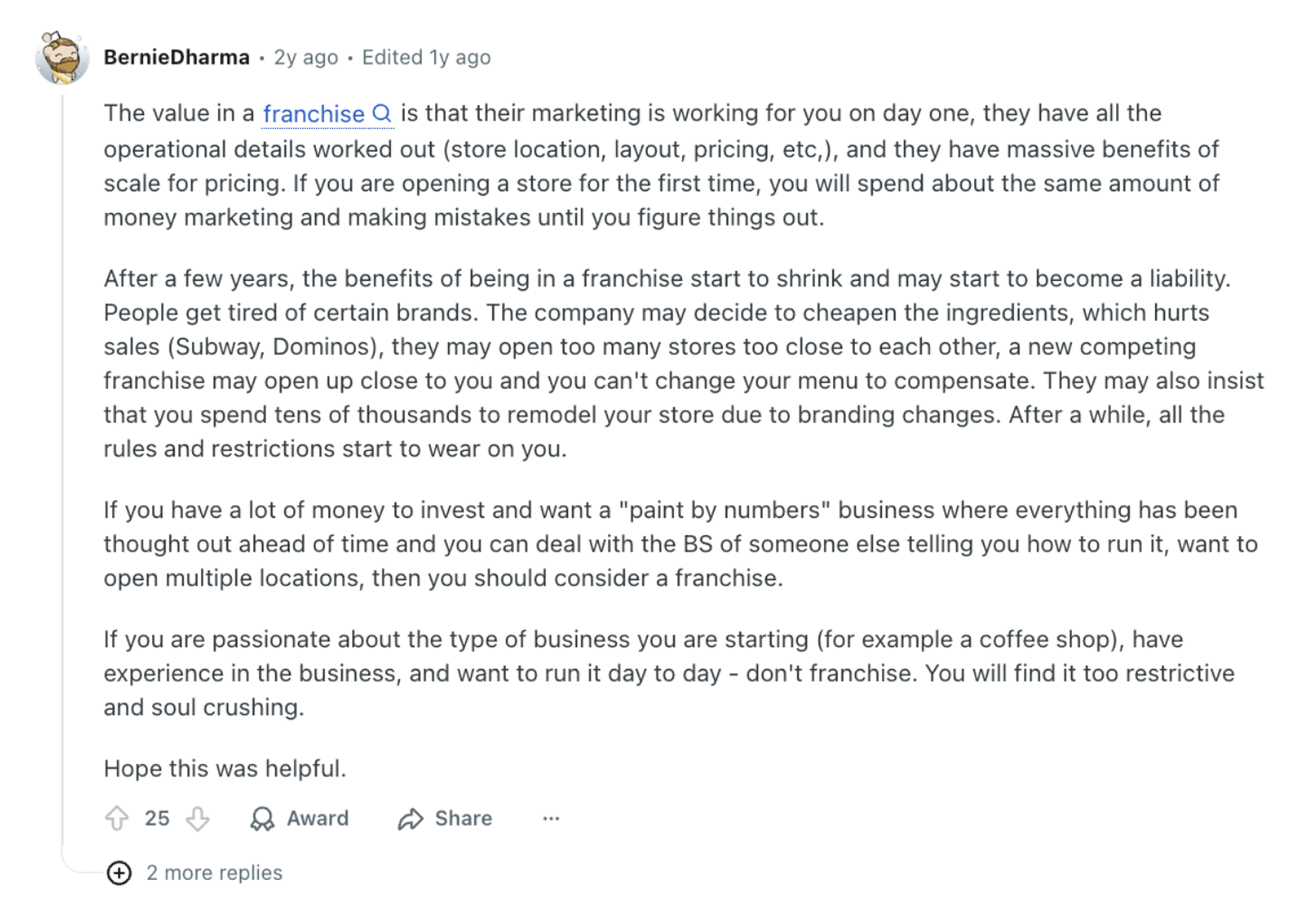
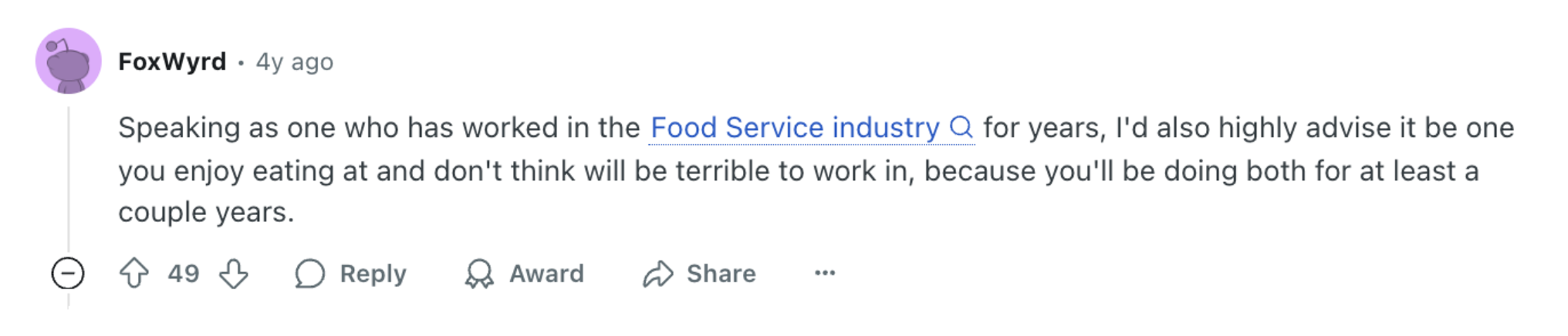
And this Redditor adds a bit more food for thought to the conversation:
|
|
|
|
 |
THE MORE YOU KNOW
|
|
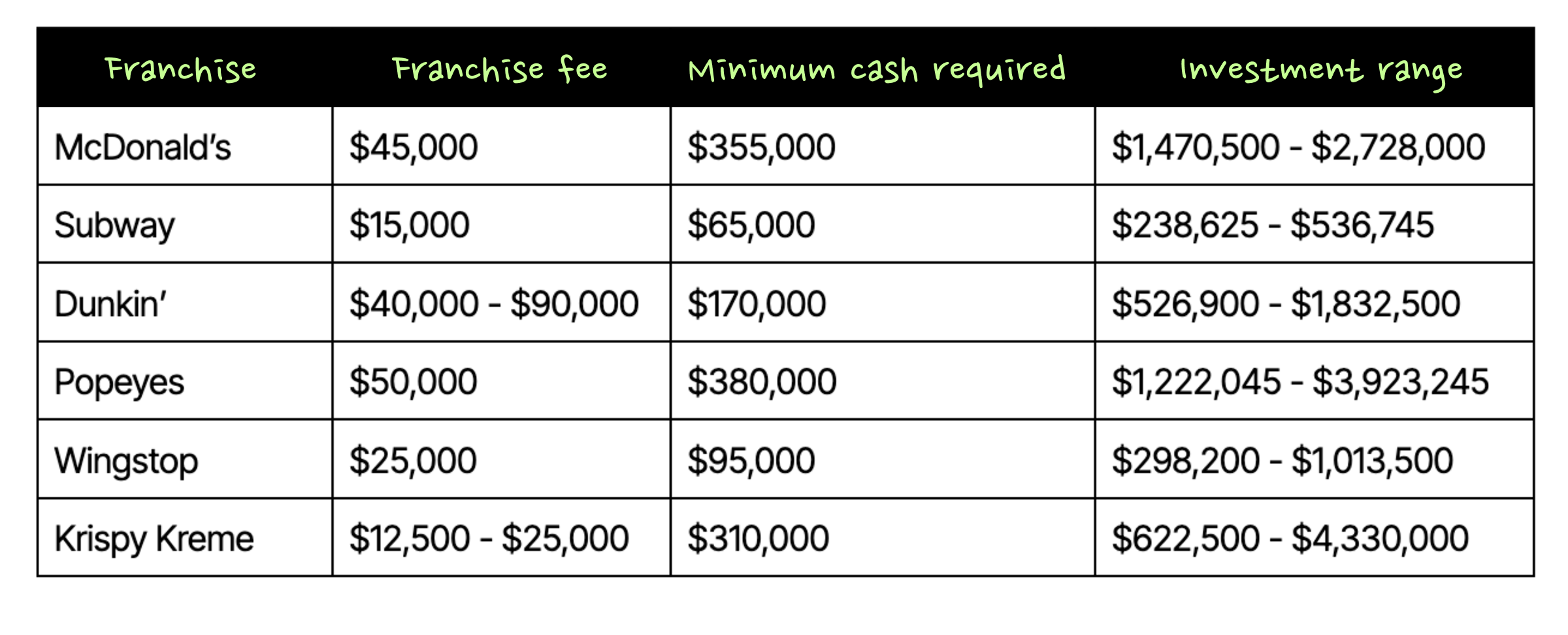
How much does it cost to open a franchise? Like the answer to most things in life: it depends.
And the biggest factor is likely the brand you’re buying into. Here’s what VettedBiz cites as investment numbers for top franchise brands:
|
|
|
Pro tip: You can pretty much find any franchise brand you’re curious about on their site––and dive deeper into startup requirements, financial performance, and all the top considerations.
|
|
|
REALLY BIG INSIGHT
|
|
Aside from making sure the brand fits your budget, there are plenty of other things to consider when choosing which franchise to buy into. This Redditor shared some solid advice on analyzing your options:
|
|
How can I find a good franchise?
You probably know them already. There’s a top 100 list for a reason. Not all of them on those lists are going in the right direction these days. Here’s some common stuff to look for:
– Unit Growth – have they consistently grown over the last 5 years? How many stores have closed in that time? Does the growth appear to be sustainable? Be wary of any franchises saying they plan to double in size over the next 1-2 years. That’s a recipe for operations nightmares and inconsistency. Definitely avoid any franchises that are contracting.
– Multi-unit ownership – get an idea for the split between single-unit owners and multi-unit. A high percentage of single-unit means you are likely buying yourself a job without great prospects. Example: Subway vs. Tim Hortons – both have some big multi-units groups, but the majority of Subways are singles. Some franchises are very hard to expand in unless you come in with huge financial backing already.
– Technology investment – cannot stress this one enough. My franchise talked about a mobile app for 5+ years and it never came out – and they already had a version of it in the US stores. Domino’s former CEO famously said they wanted to be a tech company that sells pizza, and they have crushed it in the last 10 years. Look for what the franchisor is investing in. Are they a leader with their own IT team, or just trying to keep up? Food trends change every couple years. If they’re not investing in tech themselves, they are on death row and may not even know it yet.
|
|
|
And of course, there’s this piece too:
|
|
|
|
|
 |
QUOTABLE
|
|
Restaurant investor (and former NFL player) Garrett Mills joined The Pre-Shift Podcast to break down the financials behind a strong restaurant investment. He explains the “financial trifecta,” which starts with these numbers:
- Average unit volume (AUV): How much each location sells.
- Store-level cash flow (EBITDA): What each location makes after operating costs.
- Cost to open new stores: How much it takes to get a location running.
From those, you can find out a brand’s:
- Sales-to-investment ratio: Dollars of sales per dollar invested.
- Store-level margin: Profit after direct costs.
- Cash-on-cash return: How much bang you get for your buck.
The key isn’t to nail all of these to a tee: ”To have strong cash on cash returns—let’s say that’s targeting 30% or higher—you have to have great sales-to-investment ratio and good store-level margin, or you can have great store-level margin and good sales-to-investment ratio.”
He offers Wingstop and Dutch Bros as two different examples:
🍗 Wingstop has killer sales-to-investment with just fine margins.
☕️ Dutch Bros has incredible margins but solid (not amazing) sales-to-investment.
“ I think the juxtaposition of those two concepts, both being hot commodities in our business, goes to show that there’s no kind of one right way to approach business when it comes to the financial model.”
|
|
 |
HEARD!
|
|
This one’s for operators looking to turn their business into a franchise. Shawn Saraga, Franchise Development Expert & Chief Development Officer of Tahini’s, shares what it really takes to scale your concept on The Pre-Shift Podcast.
Franchising isn’t an exit strategy: “Franchising is taking on another full-time job. In addition to the one you currently have running your business, franchising is a completely different business, a different model. You are now in the business of recruiting franchisees. You’re in the business of finding great real estate. You’re in the business of setting up operations, making sure that your stores are running properly, holding people accountable, and working with people who are there to believe in your dream and your objectives––and believe in what it is that you are trying to create. And they’re expecting you to believe in them as well.”
Signs you’re not ready to franchise: ”I would say if you’re not sure that it’s the time to franchise, it’s probably not the time to franchise. You’ve gotta be ready, you’ve gotta know what you’re getting into, you’ve gotta have the vision. You’ve gotta have the stomach for it too. At the end of the day, if you’re granting franchises to franchisees and they’re not successful, they’re gonna be coming to you, hand in hand, asking for royalty relief.”
Side note: Lauriena Borstein, Chief Operating Officer, and Kyle Mark, Chief Information Officer of WOWorks, also joined us on an episode to share the corporate perspective on franchising. They break down what it takes to build consistency from the top down, navigate change, and truly understand franchisees.
|
|
 |
QUIET ON SET
|
|
Sam Fung also breaks down five mistakes to avoid before buying a franchise. We’ll give you the first three, but be sure to watch the video to get all five in detail:
🚫 Choosing a spot without research: High-traffic areas don’t automatically mean strong sales. Study customers’ drive patterns, phone geofencing data, and even customer interests like movies or cuisine.
🤝 Signing without your own representation: Calling a number on a ‘For Lease’ sign means speaking to a broker whose job is to protect the landlord’s interest. Make sure you have an advocate on your behalf.
💰 Misjudging build-out costs: Budget for contingency funds and conduct thorough pre‑lease inspections. Or consider second-generation spaces with approved, working systems to cut costs dramatically.
|
|
|
 |
IN THE NEWS
|
|
Could your franchise be sold to a new owner—without you even knowing?
Apparently so, if you ask Allen, a Toronto Sushi Shop owner who showed up one morning at the store he ran for 13 years… only to find the locks changed.
Legally, franchise agreements often allow franchisors to terminate agreements or buy out locations if terms are violated—anything from insolvency to unpaid fees.
The takeaway? Even seasoned franchisees can face sudden changes. Know your agreement, watch for red flags, and stay proactive with communication.
|
|
|
|
STORIES FROM THE FLOOR
|
|
We asked franchise development experts—who work with franchisees every day—what tips they’d give to aspiring owners. Here’s what they had to say:
Yvis Manrique, Director of Field Ops at Toastique: “Be consistent—that is where you get results, not just when things are great. I think when things are the worst is when you have to stay consistent and remain positive, which is hard to do. But if you trust in the vision and remain consistent, it will happen.”
Julianna Blackhurst, Senior Director of Franchise Ops & Dev at Jeremiah’s Italian Ice: “Put the best team possible in place. Growth absolutely starts with a plan and a strategy, but you need people to execute it, and you need people to maintain your standards. You have to have leaders that you trust in your store to continue to grow.
|
|
 |
À LA CARTE
|
|
|
|
|
|